Beryl Gemstones - Emerald and Aquamarine
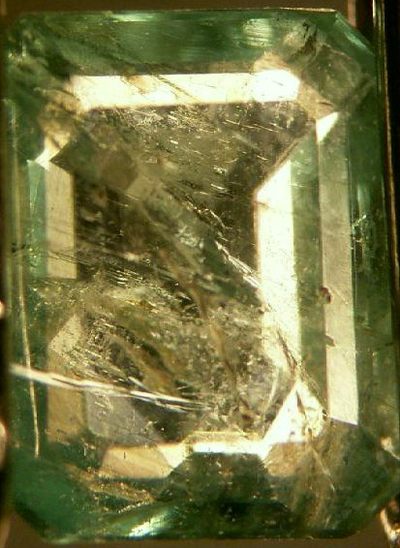
A typical emerald, with many inclusions and fractures. I have seen much worse; clear stones are rare and valuable.
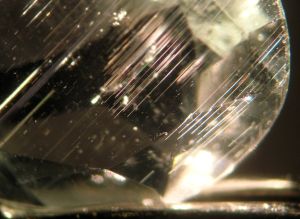
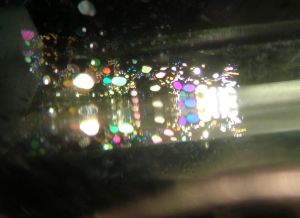
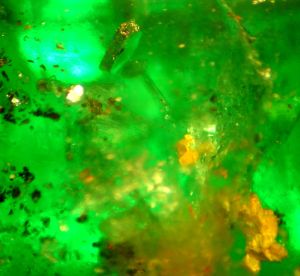
Under the microscope emeralds are wonderful. Each fracture is a pleasure, and many of the inclusions are crystals, beautiful in their own right. I can easily spend half an hour just admiring one stone!Beryl in its pure form is colourless, however various 'impurities' within the crystals give it various colours - emerald green is the best known. Beryl forms in granite and crystals (not gem quality) can weigh up to a ton! Its chemical composition is aluminium beryllium silicate.
Why are emeralds normally fractured, while most aquamarines are clear? The answer probably lies in the impurites which give emerald its beautiful colour. They also make the stone brittle, thus increasing the chance it will fracture while forming in the earth.
I have only mentioned the most common Beryl gems here. Others include Yellow Beryl and Morganite, which varies between pink, orange and purple.
Treatments before purchase
Assume emeralds have been fracture filled unless guaranteed
untreated. This filling may be lost eventually, but stones
can be re-treated. Emeralds are occasionally dyed to
improve the colour.
Aquamarine is easily available unflawed, so fracture filling is
not needed. However most stones are naturally a green blue,
and are heat-treated to remove the green tint. The
treatment is permanent
Cleaning
Beryl stones are easy to clean, but very hot liquids
are unwise. Always remember that, although hard, these stone - like
other gemstones - are somewhat brittle and can be damaged by a
severe blow.
Emeralds normally have inclusions, flaws and fracture
fillings; so they should not be soaked when cleaning. A
good emerald is valuable, we would recommend taking it to a
jeweller once a year to check its mount is secure, and the
jeweller can clean it at the same time.
Emerald
These are the bright green form of beryl and may have been
used in jewellery as early as 3500BC. However the early
emeralds were from Egypt and were badly flawed. It was only
after 1500AD that better quality stones were found in South
America.
Emeralds were the jewels of Venus, Goddess of Love. They were
thought to bring success in love. They were also linked to Diana,
guardian of women and young girls. The Ancient Egyptians believed
emeralds could heal eye diseases. They are the May
birthstone.
Aquamarine
Aquamarine means 'Water of the
Sea,' and the stone is a pale blue-green colour. As remarked
earlier, aquamarine is often found totally unflawed. It is a beautiful,
light-coloured stone.
In ancient times it was used as a protection against drowning and
sea-sickness, and was thought to bring good luck to fishermen.
It is the March birthstone.