Garnets
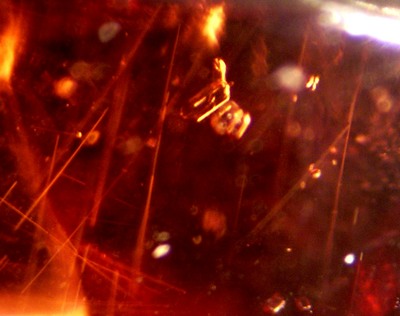
Inside an almandine garnet. The bright red colour is typical. Note the cluster of apatite crystal, including a twinned crystal. Finally rutile needless can be seen, and are aligned with the crystal planes. These are all features which made it easy to identify this stone as an Almandine Garnet. Click here for larger image
Everybody knows garnets are red, in fact many other colours can
be found - except blue.
Historical evidence suggests garnets were used from 3100BC, and
they have remained popular since the 18th century. Before
synthetic ruby was developed, garnet was often used for the
bearings in watches.
Chemically they are compound silicates, and come in a number of
different formulae. The better stones look great when faceted,
while others are given a cabochon finish. Garnets divide
into a number of different types, including Almandine, Pyrope,
and Andradite. Variation in the crystal structure produces
these different types. Differences show in a number of
ways, including the inclusions, colour, refractive index and
specific gravity. However most gems come between the types,
and include features of more than one type, therefore they are
defined by the most dominant type.
From ancient times garnets have been valued for keeping the
wearer safe from harm, and were especially prized by warriors
both to protect them from injury, and to give them a feeling of
peace and tranquillity. Curiously, they
were also believed capable of inflicting fatal wounds, and in
19th Century Kashmir garnets were used as bullets for attacking
British troops. The ancients believed the wearer would be blessed
with good health, and the stone would ward off nightmares.